Solar Radio Telescopes Available in MackSun
MackSun provides access to solar radio telescope observations generated by instruments used in solar physics, radio astronomy, and astronomical time series research.
This page presents the main characteristics of the instruments available in the portal, including POEMAS and SST, with emphasis on operating frequencies, temporal resolution, and scientific applications.
Related pages: download solar data, telescope data dictionary, how to export solar data, POEMAS solar dataset.
POEMAS
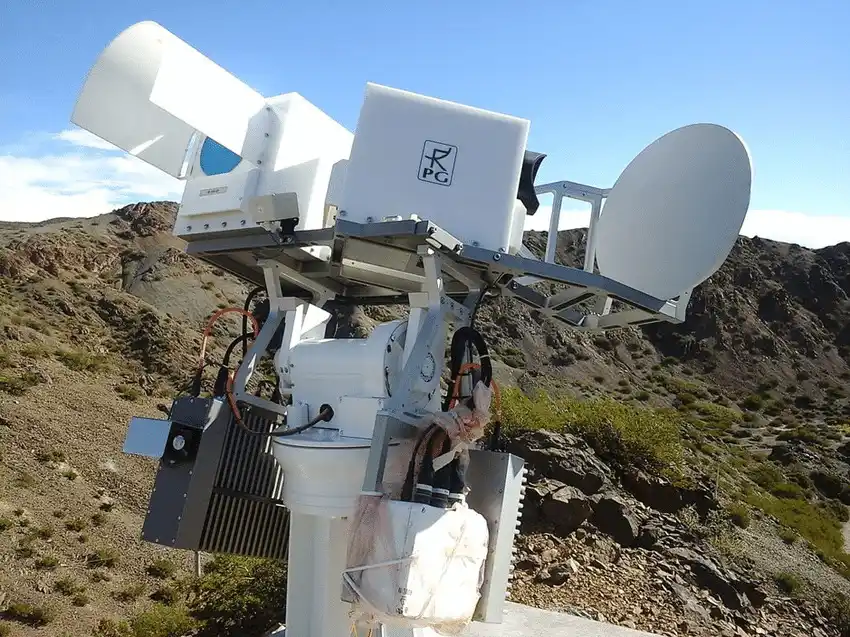
The POlarization Emission of Millimeter Activity at the Sun (POEMAS) consists of two solar
radiotelescopes operating at 45 GHz and 90 GHz, with independent detection of right and left
circular polarization. In operation since 2013 at the CASLEO observatory in Argentina,
POEMAS provides continuous monitoring of the Sun in the millimeter range.
The system achieves a temporal resolution of 10 ms, which makes it suitable for detecting fast
solar phenomena such as bursts during flares. Calibration is performed through Dicke switching
and noise diodes, ensuring stability better than 0.05 K. Each antenna has a beam with HPBW ≈
6°, with sidelobe levels below -30 dBc, ensuring reliable flux density measurements.
POEMAS data provide unique insights into the dynamics of solar flares at millimeter
wavelengths, complementing observations at radio and submillimeter frequencies.
Location: CASLEO - Complejo Astronómico El Leoncito, San Juan, Argentina.
Google Maps
SST
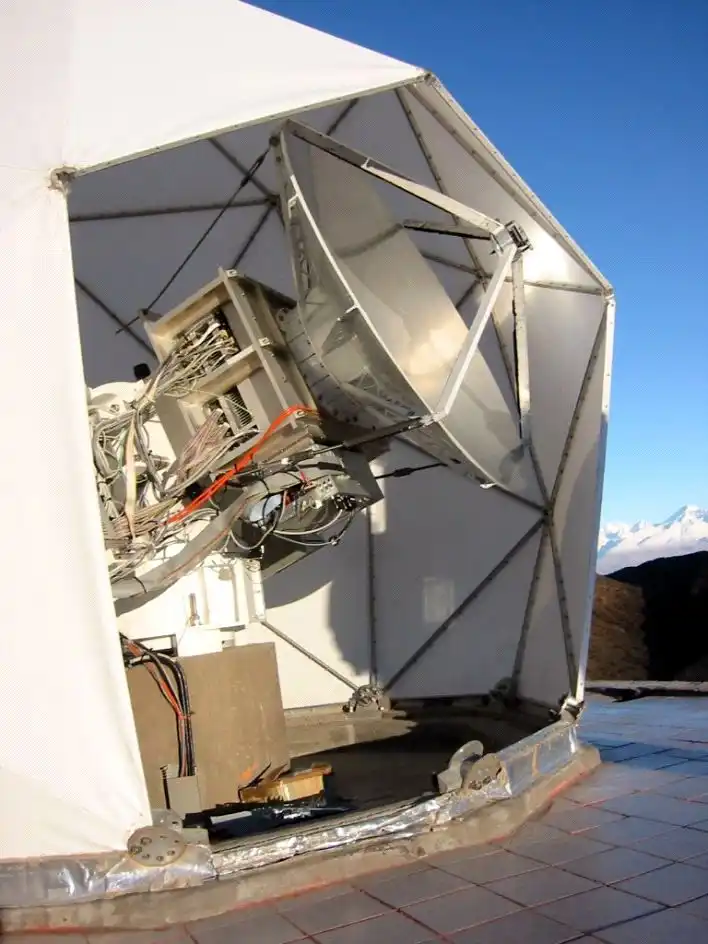
The Solar Submillimeter Telescope (SST) has been operating at CASLEO since 1999 and
was the first telescope to continuously monitor the Sun in the submillimeter domain. It
observes at 212 GHz (1.4 mm) and 405 GHz (0.7 mm) using six radiometers.
The instrument records data at different cadences:
● fast: 5 ms for transient events
● intg: 40 ms for intermediate studies
● instr: 1 s for long-term monitoring
SST employs a dual-beam system with high precision pointing, supporting solar tracking,
mapping, and atmospheric calibration.
SST data are fundamental for investigating particle acceleration and high-frequency
components of solar flares.
Location: CASLEO - Complejo Astronómico El Leoncito, San Juan, Argentina.
Google Maps